
America's Kryptonite
Truth #11 of The Thirteen Truths of Superman

Previously: we explored the progressive values Superman stands for. But now, with his greatest nemesis in the White House (again), a shadow falls across America. How did we get here? Join us as we discover the true origin story of America's Kryptonite.
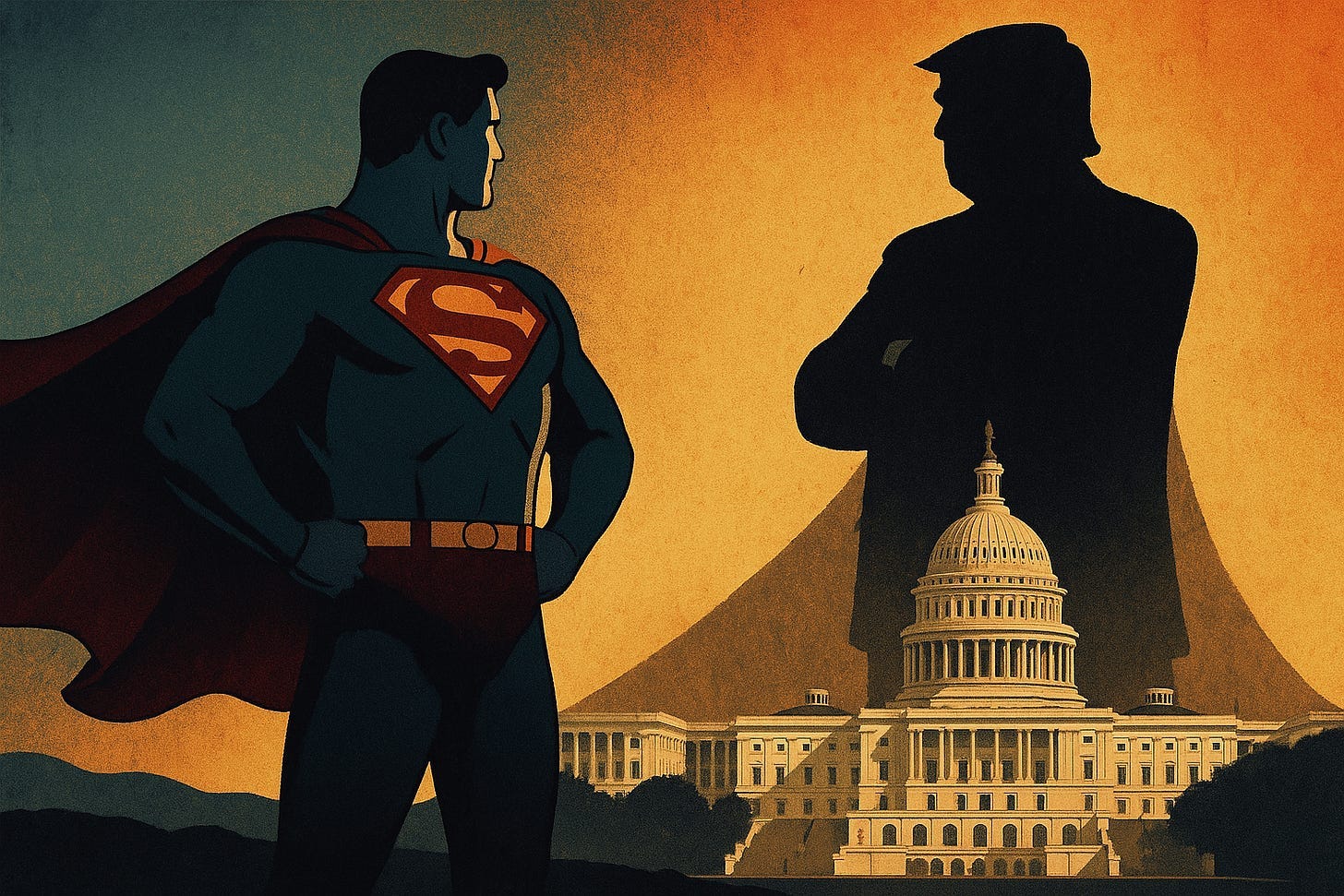
Truth #11: Unchecked Corporate Power Is America's Kryptonite
In 1986, DC Comics redesigned Lex Luthor as a billionaire businessman. The architect of the reboot, John Byrne, later confirmed: "Of course, Donald Trump was our model."
Think about that: America elected the man who served as the muse for one of history’s most iconic, over-the-top supervillains.
I could list all the parallels—both are corrupt billionaire narcissists who ran companies named after themselves, both ran for president after being humiliated at press dinners, both weaponize the state against their enemies. I could write an exhausting catalog of how life imitated art and how art imitated life.
But that would just be another laundry list of Trump's supervillainy. The far more interesting question is: what fueled our country to welcome a real-world supervillain to the White House? Not just once, but twice. The answer lies deeper than Trump himself—in the very foundation of American democracy.
Kryptonite doesn't attack Superman from outside; it's radioactive fragments of his dead world, poisoning him from within. Similarly, America's Kryptonite isn't an external threat to our democracy, it's a poison built into our constitutional DNA, fragments of old empires we never properly buried.
That poison evolved through centuries, a story written in our very skylines.
The Architecture of Power
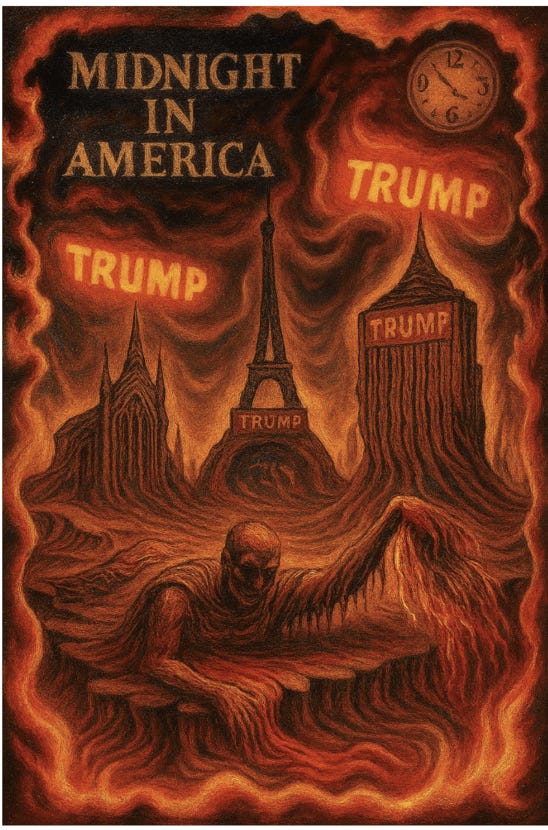
In 1985, Joseph Campbell observed that you can tell what dominates a civilization by looking at its tallest buildings.
For centuries, cathedral spires pierced the heavens—the Church reigned. By 1889, the Eiffel Tower eclipsed these holy spires, replacing tributes to God with a monument to State power.
Then in 1930, corporations had the chutzpah to stage a "Race for the Sky." The Chrysler Building—essentially a gleaming advertisement for an automobile company—surpassed the Eiffel Tower. Eleven months later, the Empire State Building rose even higher.
They even put it in the name: Empire. The Corporate Empire had literally risen above the State.
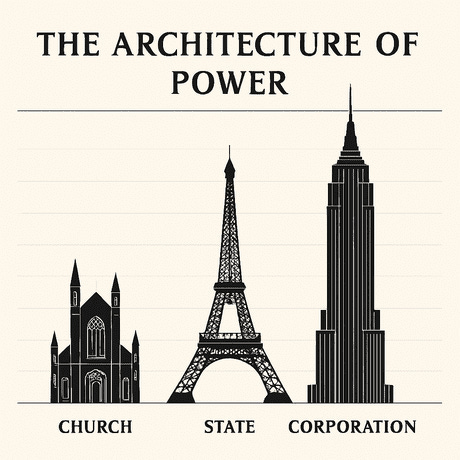
This architectural evolution reveals what our democracy failed to address from the beginning: the Constitution that carefully separated Church from State never mentioned corporations at all.
The Ghost in the Constitution
America’s founding document carries a silence so vast it still shapes us. When James Madison proposed giving Congress the power to charter corporations, the Constitutional Convention voted it down—eight states against, three in favor. But the rejection of Madison’s proposal is stranger than it first appears…
The Boston Tea Party story we learned in school was a lie of omission. It wasn’t simply about taxes. Between 1769 and 1773, the British East India Company starved up to ten million people to death in Bengal—modern-day Bangladesh and West Bengal, India. Company officials forced farmers at gunpoint to grow opium instead of rice, then collected taxes from skeletal hands. A Company officer would later confess that decades afterward, he could “still hear the mother’s shrieks and infant’s moans. Cries of despair, and agonizing groans.”
This was the corporation the colonists knew—an empire in corporate form. When Parliament gave this same company a tea monopoly in America, they weren't simply spoiled elites protesting a tax. They were fighting to keep off their shores the corporation that had just committed one of history's worst atrocities.
Yet when the framers wrote our Constitution, the word corporation appears nowhere. Not once.
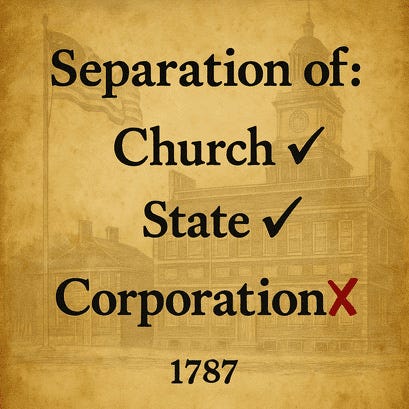
By 1816, Thomas Jefferson saw the error: banking institutions and corporations, he warned, were “more dangerous than standing armies.” Too late. The poison was already in the bloodstream.
For seventy years, that warning echoed unheeded. Then in 1886, the poison reached the heart. The Fourteenth Amendment—meant to guarantee rights for freed slaves—was twisted by a court reporter's note to grant corporations personhood. The amendment meant to end one form of property—human beings—became the basis for property itself becoming people. Think about that irony: Black Americans were being lynched for claiming personhood while corporations received it through a court reporter's note.
Like all massive institutions, corporations can achieve great things integral to our lives. But without deep regulation and checks and balances, the Corporation, like Church and State before it, is prone by its very nature to commit the most heinous crimes imaginable.
And once corporations had the rights of citizens, they needed only to ensure that white and Black citizens never stood together. Division was their technology of control. Racism was the perfect tool, poisoning solidarity before it could form, turning potential allies into enemies, and ensuring those who most needed power could never unite to take it back.
In modern Bengal, they still sing songs remembering the millions killed by corporate greed. In America, our Constitution was built on forgetting them.
Sunrise, Sunset
For over a century, the pattern held: profit required division, and division protected profit. Then in 1929, unchecked corporate speculation brought its inevitable result: total collapse.
If 1929 was darkness, 1933 brought twin lights: FDR's New Deal and Jerry Siegel's first sketch of Superman, imagined with his friend Joe Shuster—two Jewish kids, the children of refugees, dreaming up a hero powerful enough to stop what was happening to their people in Europe.
From 1933 to 1980—the Superman Years—America briefly contained the corporate beast. Not perfectly. The military-industrial complex fattened on Vietnam. Segregation persisted. The FBI surveilled, sabotaged, and targeted Black leaders for destruction. Even as he battled the KKK and got kids to swear off smoking, Superman himself wasn't immune to corporate corruption. Jerry Siegel and Joe Shuster sold their creation for $130 and spent decades in poverty while their character generated billions. The corporation that owned him would eventually use his image to sell cigarettes to children, transforming a symbol of collective good into poison for private profit. If corporate power could corrupt even Superman, what chance did democracy have?
And yet, regardless of the many problems of this era, the trajectory bent toward justice. Union membership soared. The middle class expanded. By 1965, the Voting Rights Act extended democracy to millions of Americans previously excluded. It was high noon for American democracy. By 1978, the top 0.1% controlled just 7% of national wealth—their smallest share in U.S. history. Medicare, Medicaid, Social Security, and the War on Poverty—exactly the kinds of initiatives Superman championed—lifted millions. For one brief, shining moment, it seemed the American Way might actually triumph.
Tragically, in America, every expansion of liberty triggers contraction.
The Powell Memo of 1971 crystallized a backlash already brewing; a corporate counterrevolution to capture the courts, fund think tanks, reshape universities. Over the next decade, corporate elites mobilized with unprecedented force. By 1980, their counterrevolution stood triumphant, crowned by Ronald Reagan’s election.
Reagan declared war on the New Deal under the banner “Make America Great Again"—the first MAGA, disguising corporate liberation as individual freedom. His genius wasn’t just destroying regulations; it was making workers cheer for their own chains. And as always, the engine driving the whole scam was racism.
As Reagan rose to power, one of his campaign strategists, Lee Atwater, said the quiet part out loud in 1981: you could no longer say the N-word in polite society, so you said "tax cuts." Everyone knew the code. White voters understood these cuts targeted programs they associated with Black people. The brilliance—and the tragedy—of the strategy was persuading white working families to dismantle their own safety net, so long as they believed Black families would suffer more.
This ancient, race-based corporate strategy has even deeper roots. If the second multinational corporation committed genocide in Bengal, what did the first one do? It built the slave trade—kidnapping, shipping, separating, raping, torturing, and selling human beings. And that was just the start. JPMorgan Chase and Wells Fargo descend directly from banks that accepted enslaved people as collateral. Wall Street itself is named for the wall enslaved people were forced to build.
Reagan's MAGA movement weaponized this ancient corporate strategy from the Oval Office. George W. Bush would later follow suit. But the full release would require someone with no shame; someone who didn't need to disguise division as freedom.
That someone was already out there, perfecting shamelessness as strategy and grievance as currency. When the Civil Rights Act passed, he blocked Black families from his buildings. During Reagan's backlash, he demanded execution for five innocent Black teenagers—reviving the lynching tradition that murdered Emmett Till and countless Black boys and men. Hours after 9/11, he went on TV to brag that his building was now the tallest in downtown Manhattan—a lie. When America elected its first Black president, he led the birther conspiracy. Each moment of American progress triggered his escalation. This wasn't madness; it was method.
For decades, Trump had perfected division as a business strategy. When his casinos collapsed, when his airlines failed, when every actual business imploded, banks labeled him 'too big to fail,' not because he was good at business but because he was good at performance. His towers weren't profit centers; they were transmission sites for his own manufactured mythology.
In Trump, the Corporate Empire had found its future emperor. Every corporate sin had prepared his throne: the racism that divided workers, the greed that would see Gaza as beachfront property, the sexual predation that turned women into objects, the extractive mindset that would burn the world to maintain the old hierarchies.
And the unchecked corporation's greatest triumph: the me-first consumerism that would replace solidarity with selfies, until Americans could no longer imagine collective resistance—only individual brands. Trump wasn't corrupted by power—he was corporate consciousness in human form: a cheap knock-off of a golden calf, presenting itself with orange hair and a red tie.
Reagan had to speak in code—“welfare queens” and “states’ rights.” Trump bullhorn appeals to racism dispensed with code entirely. The racist division that once protected profit became the product itself.
But Trump's talent for turning division into product still needed a delivery system big enough to carry it everywhere—something that could outscale even his ego. He'd spent decades as capitalism's clown, gaming old-media gatekeepers: tabloids, talk shows, cable news. But gatekeepers made him a punchline, not a president. He needed a way to short-circuit them entirely. The real jackpot wasn't in headlines or prime-time interviews. It was in something vaster, faster, and more addictive than television: a new empire that could beam grievance into every pocket on Earth.
That empire was already taking shape, but not in the form anyone expected. In fact, it wouldn't be a building at all, but something far higher and more inescapable than anyone could have imagined.
The Empire Above
By 2001, corporate monuments glittered across every American skyline. Then came a September morning when two planes destroyed capitalism's twin cathedrals.
Beyond the unthinkable horrors of 9/11, something subtler died: the myth of the highest building as invincible. For millennia, power had an address—St. Mary's Church, the Eiffel Tower, the Empire State Building, the World Trade Center. You could reach for it, fight it, fear it, worship it.
But though it was unexpected, the infrastructure for power's next form had been growing for decades. Since the 1950s, the tallest buildings had been crowned with antennas. Height became about transmission—who could broadcast from the highest point. Madison Avenue discovered you could colonize consciousness itself through carefully crafted 30-second ads. When the towers fell, the antennas pointed toward power's future: pure signal, no structure needed.
Into this vacuum rose a power higher than any building: the Cloud—Silicon Valley's ethereal metaphor for an empire of data centers consuming more energy than entire nations.
The Cloud floats above every cathedral, tower, and skyscraper—invisible, omnipresent, inescapable.
It inherited everything: the Church's hunger to track souls, the State's power to count citizens, the Corporation's ability to turn anything into property. But the Cloud perfected what they all attempted—turning human consciousness itself into the product. What the antennas started, the Cloud completed.
Notably, the heart of Silicon Valley beats not in towering skyscrapers, but in sprawling, low-slung campuses—Google, Apple, Meta—with large local sites from Microsoft and Amazon. These tech giants eschewed the symbolic might of the high-rise in favor of horizontal empires, hidden in plain sight. Post-9/11, we're no longer impressed by companies that reach for the sky. We're impressed by companies that have become the sky.
Consumer capitalism had taught us to buy what we don't need. Surveillance capitalism would teach us to surrender what we can't replace: our attention, our privacy, our ability to see reality itself.
In fact, what began as tech companies became what Ezra Klein calls "attention oligarchs"—merchants of human consciousness itself. And as Klein notes, attention, not cash, is the currency that most interests Donald Trump. The titans arrayed at his inauguration weren't there for their money, but for their control over the only resource that matters in an empire like this: the human psyche.
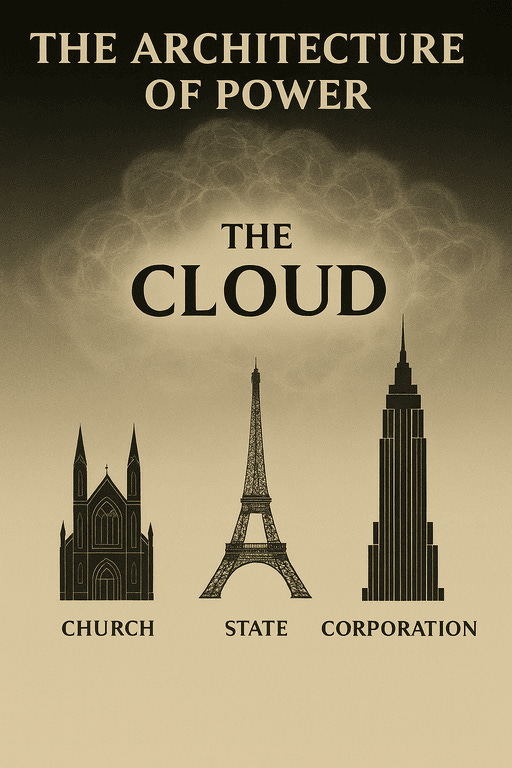
This wasn't just another corporate evolution—it was a new species of capitalism. Traditional corporations sold us products; the Cloud sells us as the product. Where consumer capitalism extracted value from our wallets, surveillance capitalism extracts value from our attention, our data, our very selves.
We became the commodity. But it's worse than that. Every wisdom tradition recognizes something sacred in human connection. Jesus said, 'Where two or three are gathered, there am I among them.' This is the space between souls where meaning emerges. As the musical Les Misérables reminds us, 'to love another person is to see the face of God.' The Cloud studies that face, maps it, owns it, sells it. They're buying what's holy and selling it for parts—splitting up God and selling the Divine, all the while claiming to own the heavens.
And they're burning down the Earth to do it—not to solve humanity's greatest challenges, but to perfect surveillance, optimize addiction, and serve ads.
Every once in a while these attention merchants reveal their heist. In May 2024, Apple accidentally told the truth. Their iPad commercial showed a hydraulic press crushing a piano, guitars, art supplies, books—all of human creativity compressed into a thin tablet. The backlash was immediate. Actor Hugh Grant captured it perfectly: 'The destruction of the human experience. Courtesy of Silicon Valley.'" Apple apologized, claiming to have made a mistake. That is, if honesty is a mistake.
The revolution had been corporatized. Apple went from an ad opposing the Orwellian future of 1984 to becoming Brave New World. Google went from 'Don't be evil' to essentially dropping the 'Don't.' Twitter went from the Arab Spring to being the launchpad for fascists to take the White House. Ultimately, Silicon Valley's greatest trick was selling us our own subjugation as 'super hip,' frictionless liberation.
And like Apple’s hydraulic press, the Cloud’s algorithm crushes everything it touches. It crushed Molly Russell, feeding the fourteen-year-old thousands of images of self-harm until she took her own life. It crushed Joyce Jones’s historic run to become Montevallo, Alabama’s first Black mayor, turning lifelong neighbors against her through weaponized lies. In Myanmar, it crushed an entire people—Facebook's algorithm amplifying violently Islamophobic posts calling for Rohingya families to be burned alive, enabling what UN investigators called its 'determining role' in genocide.
“What happens on Facebook doesn’t just stay on Facebook,” Jones said. “It goes home with us.”
Jones learned what we’re all learning: what happens in the Cloud doesn’t stay in the Cloud. It reshapes reality itself.
And no one grasped this more instinctively than Donald Trump. His career was built on the Cloud’s two prime directives: distraction and division. The algorithms perfected what ad executives always knew: fear beats facts, rage beats reason.
But Trump wasn't reshaped by social media; he was already its logic in human form. Decades of corporate consciousness had hollowed him out until he ran on the same code as social media: seek attention, sow division, deny reality. The Cloud had been searching for its avatar, and Trump had been searching for his empire. When they found each other, it was love at first hate.
Listen to him speak and you hear what Klein recognized: “Imagine Trump as a golem summoned by the attention economy. We are being governed by the human embodiment of the Twitter algorithm.” A golem—like Superman, but animated by his Bizarro self. Where Superman was the golem of truth, justice, and the American way, Trump is the golem of lies, division, and corporate dominance.
Of course, our mythologies always catch up to our monsters. Just as John Byrne once modeled Luthor after Trump, in 2025, James Gunn updated Luthor for the Cloud era: commanding armies of monkeys to spread toxic lies on social media, turning the government into his personal ATM, disappearing people into pocket dimensions for torture. Our mythology had to evolve—from the villain who built towers to the villain who builds reality itself, often through the very phones in our pockets, each one a pocket dimension threatening the fabric of all our relationships.
That some of these villains turn on each other (in an argument over which billionaire rightfully owns American democracy) only proves the point: there's no solidarity among the real world clones of Lex Luthor, only competition over who gets to hold the chainsaw.
This is our Kryptonite, and it is killing us—not in the abstract, but in the flesh. On July 4, 2025, Trump signed what he called his 'Big Beautiful Bill.'
No one would argue that the bill is big. But beautiful? Over 50,000 Americans killed each year from Medicaid cuts. Medicare and Social Security on the chopping block. Concentration camps for immigrants. A trillion dollars funneled to billionaires in the largest, most transparent heist in American history. While stripping renewable energy funding that could save the planet, he hands billions to the very corporations burning it down—paying them to accelerate our extinction.
This is what the algorithm calls beautiful: a death cult of suffering, optimized for short-term profit, headed for the destruction of everything.
The con that started with Reagan's dog-whistling 'tax cuts'—getting white Americans to destroy their own safety net just to hurt Black Americans—has become a primal scream. Trump's supporters now cheer for their own execution. This is the ultimate triumph of corporate consciousness: Neil Postman warned we were amusing ourselves to death. Trump proved we'd literally vote for it.
This is the algorithm's vision of paradise—the destruction of the human experience, optimized for a small handful of trillion dollar companies, headed for the annihilation of everything.
Midnight
The founders separated Church from State but left Corporation free to devour both. From the East India Company's genocide in Bengal to Facebook's genocide in Myanmar, from enslaved bodies as collateral to human consciousness as commodity—the poison they refused to name has evolved beyond their darkest fears.
In fact, they feared a tyrannical president who would abuse the state. But that's just one empire! With Trump's second term, for the first time in American history, one man commands all four empires. He's twisted the State into a weapon of mass deportation and martial law. He's made that same State bow to fundamentalist versions of the Church. All while harnessing the greed and chaos of both the Corporation and the Cloud to cloud our ability to see our way through.
Corporate titans who once feigned resistance now pledge billions. Universities that preached courage teach compliance. The media that exposed his crimes now platforms his lies. Each surrender emboldens the next, a cascade of cowardice that would have been impossible if the founders had written one word—corporation—into their safeguards.
In 1986, DC Comics gave the truth a face: they redesigned Lex Luthor as Donald Trump. In 2025, Trump redesigned America as LexCorp.
During those Superman Years, the American Dream was on the rise. FDR brought dawn. The Civil Rights movement brought high noon. Then Reagan promised "Morning in America"—but Reagan brought dusk.
And Trump?
Trump brought midnight.
Now is the time of monsters.
Tune in next time for the intense and startling conclusion of the Thirteen Truths of Superman.
Oh, Andrew. What you say is true and disheartening. We have traded our souls for avarice. Every time I see or hear Trump I am reminded that we were sold a bill of goods and we did this to ourselves. We are in the thrall of a man who would be king. His latest attempt to whitewash history by attacking the Smithsonian proclaiming that slavery wasn't that bad makes me weep. The worst part is that there are so many who believe it. I honestly don't know where we go from here. I'll read what you write and try to keep hoping. I wish I could do more, but I no longer have the wherewithal to do so
Andrew, can you reach out to me, please? I accidentally subscribed to your Substack yesterday with a rather large contribution BY MISTAKE, thanks to Substack's very weird system. (I meant to make a donation to Bill McKibben's Substack.) I'm sure your cause is a good one, but it's not the best fit for me. My email is mollyvschen@gmail.com